

Beyond Cyber Awareness: Turning Vigilance into Continuous Resilience

Cybersecurity Awareness Month has been helping to educate businesses about emerging threats for over two decades. But true cyber resilience isn’t just about awareness of what the bad guys are doing. It also demands an understanding of whether the controls put in place to mitigate cyber risk are working as intended.
How many organizations can spot when these controls fall out of alignment, and take immediate action? This is the promise of continuous controls monitoring (CCM).
Resilience Is the Gold Standard
Resilience is where global regulators are increasingly focusing, and for good reason. The best-funded, most mature cybersecurity function in the world can’t promise that its organization will be 100% breach proof. Incidents will inevitably occur. Data will be stolen. Business processes will be disrupted. It’s how the organization reacts that matters. Can it continue to run minimum viable operations while containing the threat and recovering? And does it layer up controls and defenses so that no single failure is catastrophic? This is what the Fed expects of financial institutions. It’s what EU regulators require under DORA and NIS2. It’s what HIPAA is working towards. And it’s what best practice standards like NIST CSF 2.0 and SP 800-160 Vol. 2 demand.
But no organization operates in a vacuum. The risk landscape is in constant flux. New threats emerge on an almost daily basis. IT configuration changes happen with dizzying frequency. Business processes evolve, teams change, and regulations mature. This volatility can spell trouble for organizations still managing risk the old way.
Where Legacy GRC Fails
Legacy GRC was not designed for this pace of change. It is geared towards providing a static, point-in-time view of risk and compliance posture. As a result, compliance can become divorced from operational security, with teams relying on periodic attestations rather than continuously validating that controls remain effective.
This matters, because when controls drift, they may no longer be effective in mitigating the risks they were designed to address. A large, highly regulated organization might run thousands of such controls. Among the most prone to drift are configuration management baselines managed through DevOps tools like Terraform or Ansible; especially cloud security groups, IAM role policies, and OS-hardening configurations. These tools may reduce the risk from manual changes, but AI mistakes are introducing a new source of risk in production environments.
Some expose the organization to greater risk than others. If public ingress rules drift, they could dramatically increase the attack surface. Privileged IAM access is another high-risk area, where drift could open the door to lateral movement, MFA bypass, privilege escalation, and much more.
AI adoption is sharpening these challenges. As AI-generated code volumes grow, there are more opportunities for configurations to diverge from security baselines. RAG and agent architectures are dynamic, so the way AI accesses data can change faster than the controls designed to govern it. And shadow AI bypasses GRC controls altogether.
Turning Visibility into Continuous Resilience
There is a better way, and it begins with continuous visibility. Legacy GRC typically involves periodic assessment of the control environment, leaving gaps between checks. And it’s in those gaps that controls can drift from their intended state. This is where CCM comes in.
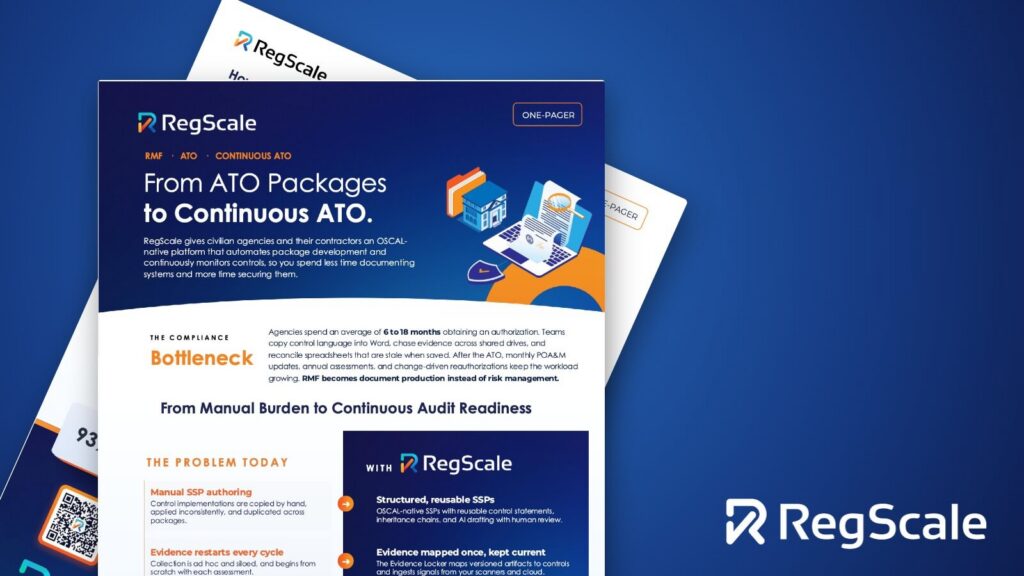
It’s built on a compliance-as-code approach that bridges the divide between GRC, SecOps, and DevOps. Compliance as code uses open standards OSCAL and OCSF alongside the Open Policy Agent (OPA) and SBOMs to transform controls into machine-readable form. RegScale connects these controls via APIs to evidence generated by security tools and IT infrastructure across the enterprise. Instead of teams being forced to manually collect this evidence periodically, RegScale continuously monitors for drift, matching evidence against the control baseline in real time.
If a mismatch is identified, RegScale automatically generates a POA&M and sends a remediation ticket to Jira or ServiceNow. When the change has been made, RegScale auto-validates, closing the issue and updating compliance evidence. No manual paperwork. No hassle. No weeks of control drift. And minimal exposure to risk.
The same compliance-as-code approach can be integrated into CI/CD pipelines to prevent non-compliant code from ever getting into production.
Accelerating Governance Risk and Resilience
The result is the “always audit-ready” enterprise, where compliance is an outcome of resilience rather than the goal itself. We like to call it: Governance, Risk and Resilience (GRR). GRR gives you the automated, real-time tracking required to match the speed of modern adversaries. It transforms compliance into a dynamic defense system. In this way, compliance is an outcome of being resilient; it shouldn’t be the goal.
If Cybersecurity Awareness Month is about empowering organizations to reduce cyber risk and improve resilience, then there’s no better place to start than shifting from GRC to GRR.
Ready to get started?
Choose the path that is right for you!
Skip the line
My organization doesn’t have GRC tools yet and I am ready to start automating my compliance with continuous monitoring pipelines now.
Supercharge
My organization already has legacy compliance software, but I want to automate many of the manual processes that feed it.