

VDR and VER for FedRAMP 20x
FedRAMP is replacing severity-driven vulnerability management with two rulesets that decide how you find vulnerabilities, how you justify what you found, and who gets to see it. Here is what each one requires, and how RegScale delivers it.
DEC 7 2026 Mandatory adoption date for VDR and VER across every cloud service offering.
What VDR and VER actually are
RegScale’s continuous controls monitoring platform dramatically reduces the time to obtain an ATO, eliminates risk by integrating continuous monitoring, and future-proofs your program with NIST OSCAL.
VDR
Vulnerability Detection and Response
How you find vulnerabilities inside the authorization boundary, and how fast you are required to act once you do. Under VDR, remediation timing follows real exposure and exploitability rather than a scanner’s severity label. A Common Vulnerability Scoring System (CVSS) base score no longer sets a deadline on its own.
VER
Vulnerability Evaluation and Reporting
How you justify each rating and how you disclose it. Evaluations have to be reproducible, evidence-backed, and defensible to a third-party assessor. Results go to your federal agency customers and their Authorizing Officials continuously, not in a package assembled once a month.
Why the rules changed
For more than a decade, a Critical finding carried a 30-day clock whether it sat on an isolated test database with no route to the internet or on a production load balancer serving federal traffic. Teams spent their capacity on findings that could not be reached and their patience on deadlines that could not be defended.
CISA’s Binding Operational Directive 26-04 ended that. It reprioritizes remediation around whether a vulnerability can actually be exploited, and FedRAMP has aligned VDR and VER to it. Four questions now decide the clock on every finding:
|
EXPOSURE |
Is the vulnerable asset publicly exposed to the internet? |
|
KEV |
Is the vulnerability listed in CISA’s Known Exploited Vulnerabilities catalog? |
|
AUTOMATABLE |
Can an adversary exploit it automatically, without a user taking an action? |
|
IMPACT |
Does exploitation hand over partial or total control of the asset? |
When every answer is yes, the remediation window closes in days. When the finding is internal and cannot be exploited, the window stretches to something an engineering team can plan around. The vulnerability did not change. The context did, and the context is now part of the record.
Why changes on the ground
The severity-driven regime
- Every High and Critical finding inherits the same 30-day clock
- An isolated test database is treated like an internet-facing load balancer
- Compensating controls earn no formal credit toward the deadline
- Agency customers wait on a monthly spreadsheet someone has to build
Under VDR and VER
- Clocks run from days to months based on actual exposure and exploitability
- Reachability and asset criticality are inputs to the rating, not footnotes
- Evidence-backed mitigation lowers the rating and moves the deadline
- Agency customers and Authorizing Officials read live posture themselves
One pipeline, from scanner to Authorizing Official
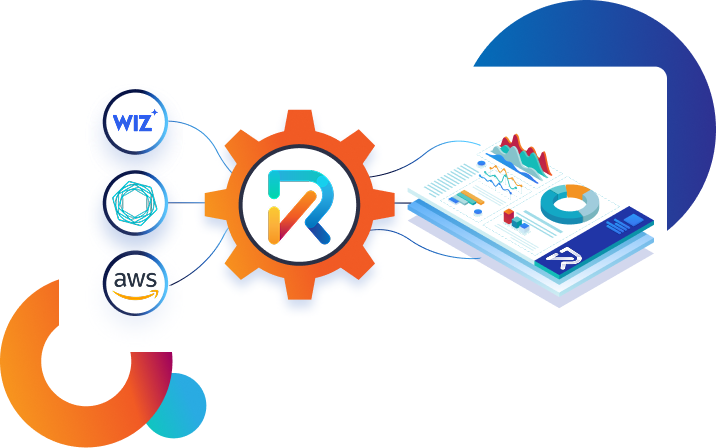
RegScale evaluates findings against the CR26 risk rules and hands the result to Trust Center over an authenticated, read-only pipeline. Your agency customers and their Authorizing Officials read live posture from that pipeline. Nobody on your security team assembles a package to make it happen.
Scanners & Cloud
RegScale VDR / VER Engine
RegScale Trust Center
Agency Customers & AOs

Scoped service account authentication
Trust Center authenticates as a dedicated, audited, non-interactive service account. Access is strictly read-only and limited to the security plans you authorize, so the pipeline can never write back into your system of record.

Continuous machine-readable ingestion
On a recurring scheduled sync, Trust Center retrieves the monthly Vulnerability Data Template (VDT), Assessment Validation Infrastructure (AVI), and High-Level Obligations (HLO) documents RegScale generates, satisfying machine-readable reporting without a manual export step.

Live federal agency customer dashboards
Trust Center ingests Potential Adverse Impact (PAIN) ratings, overdue metrics, and classifier exposure in real time. Multi-tenancy, driven by the plan’s agency customer roster, ensures each federal customer sees only the cloud service offerings they subscribe to.

Authorizing Official self-service monitoring
Authorizing Officials and Information System Security Officers get their own continuous monitoring portal to inspect compliance posture, risk acceptances, and mitigation reduction ladders on demand, without asking your security team to build a custom export.
Two ways to go deeper
RegScale’s Approach to VDR and VER
A two-page brief covering what the rules require, what changes for your team, and how the RegScale pipeline delivers evaluation and reporting end to end.
CR26 Readiness Workshop
A working session that maps your current detection, evaluation, and reporting practice against the VDR and VER rules and names what your team still has to close. You leave with a dated plan, not a demo recap.
RegScale is Class D (High) Certified