

Shift Left, Scale Fast: RegScale Integrates OpenSSF Security Baseline for Modern DevSecOps

Software development moves at the speed of innovation, but securing the open-source software (OSS) that powers enterprise applications shouldn’t slow you down. The open-source ecosystem is foundational to DevSecOps pipelines everywhere. However, keeping track of your dependencies’ security maturity and proving that compliance to your auditors has historically been a manual, slow-moving process.
Today, RegScale is fixing that. We are thrilled to announce our native support for the Open Source Security Foundation (OpenSSF) Open Source Project Security Baseline, bringing automated, machine-readable security health directly into your RegScale DevSecOps solution.
What is the OpenSSF Security Baseline?
The OpenSSF Open Source Project Security Baseline is an initiative designed to establish a minimum definition of security requirements for open-source projects relative to their maturity level. Built around core Control Families—such as Access Control, Build & Release, Quality, and Vulnerability Management—the baseline provides distinct criteria (MUST and MUST NOT requirements) to evaluate a project’s security stance.
Crucially, the OpenSSF maintains these definitions in structured data formats utilizing the Gemara Layer 2 schema and natively exports them to the National Institute of Standards and Technology’s (NIST) OSCAL (Open Security Controls Assessment Language) format.
The Power of the OpenSSF Ecosystem in RegScale
While the Security Baseline defines the requirements, the broader OpenSSF ecosystem provides the tooling to verify them automatically. By combining RegScale’s continuous compliance platform with OpenSSF’s powerhouse security tools, organizations can achieve a state of high assurance—proving that code is secure, untampered, and compliant from repository to production.
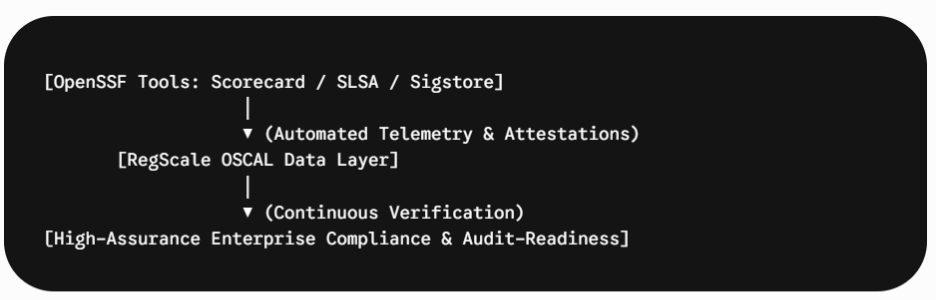
Here is how you can stack OpenSSF tools alongside the Security Baseline inside RegScale to build an bulletproof supply chain:
1. OpenSSF Scorecard + RegScale: Automated Control Evidence
OpenSSF Scorecard automatically evaluates open-source projects against critical security heuristics like branch protection, signed commits, and active maintenance, spitting out a risk score from 0 to 10.
- The Better Together Story: Instead of manually filling out self-assessments for the OSPS Baseline, you can feed Scorecard’s automated JSON metrics directly into RegScale. RegScale maps those metrics directly to OSPS controls. A passing Scorecard check instantly updates your RegScale system security plan (SSP), providing continuous, real-time evidence generation without human intervention.
2. SLSA (Supply Chain Levels for Software Artifacts) + RegScale: Tamper-Proof Pipelines
The SLSA framework provides a checklist of standards and controls to prevent tampering and improve the integrity of infrastructure packages.
- The Better Together Story: As software moves through your CI/CD pipeline, SLSA provenance tracking generates attestations proving exactly how and where an artifact was built. RegScale ingests these SLSA attestations as machine-readable evidence blocks, verifying that your build process fulfills the mandatory “Build & Release” control families within the OpenSSF Baseline.
3. Sigstore + RegScale: Validating Artifact Cryptographic Integrity
Sigstore handles keyless signing and verification for code and build artifacts, making it easy to confirm that dependencies haven’t been swapped out or altered mid-stream.
- The Better Together Story: RegScale’s DevSecOps integration watches for Sigstore signatures at deployment time. By confirming that an artifact has been cryptographically signed and recorded in a public ledger, RegScale can automatically mark identity and verification compliance checks as “Satisfied,” locking down your production environments against unauthorized supply-chain injections.
Better Together: Compliance as Code
The core challenge with open-source security standards isn’t the data—it’s the delivery. Traditionally, developers have to read static security checklists, while security teams copy-paste that info into governance, risk, and compliance tools.
Because OpenSSF and RegScale share a vision of Compliance as Code, this integration eliminates that friction entirely.
- Unified DevSecOps Dashboarding: Instead of checking disparate dashboards for your application code and third-party dependencies, RegScale provides a single pane of glass. You see your code vulnerabilities side-by-side with the OpenSSF baseline maturity markers and Scorecard telemetry of the libraries you rely on.
- Audit-Ready OSCAL Packages: Because the OpenSSF baseline compiles directly to OSCAL and RegScale is built natively on OSCAL principles, you can automatically output machine-readable documentation that proves your software supply chain’s integrity to regulators or enterprise clients in seconds.
Try It Today
Native support for the OpenSSF Open Source Project Security Baseline is available right now inside RegScale. By pairing it with Scorecard, SLSA, and Sigstore telemetry, you can transform open-source risk tracking from a guessing game into a high-assurance, fully automated compliance engine.
Ready to get started?
Choose the path that is right for you!
Skip the line
My organization doesn’t have GRC tools yet and I am ready to start automating my compliance with continuous monitoring pipelines now.
Supercharge
My organization already has legacy compliance software, but I want to automate many of the manual processes that feed it.