

Why Security Is the Foundation of Compliance

For many organizations, compliance is still seen as a cost of doing business rather than a driver of competitive advantage. But it doesn’t have to be like this. By building GRC programs on a foundation of operational excellence in cyber defense, organizations get better outcomes all around. Reduced security risk. Enhanced trust with customers and regulators. Greater agility responding to new regulatory demands.
In this way, compliance is the byproduct, rather than the driver, of an effective cybersecurity strategy.
A Losing Battle
Regulators are losing the battle to keep their standards, frameworks and directives up to date. The pace of technological change is dizzying. Infostealers are flooding the cybercrime economy with compromised credentials. Expanding supply chains are creating new visibility and control gaps. And AI is both expanding the corporate attack surface, and arming adversaries with powerful new offensive tools.
Frontier models promise to collapse the exploitation window. Mean Time to Exploit (MTTE) already stands at -2 hours, according to one estimate. But even less powerful models can do significant damage. Researchers recently discovered an adaptive and fully automated ransomware campaign driven by agentic AI — the first-known sighting of such a threat in the wild. Technology is lowering the barrier to entry for opportunistic cybercriminals. And making relatively sophisticated, large-scale campaigns commonplace.
According to Verizon, the median threat actor researched or used AI assistance in 15 documented techniques last year, with some using as many as 40 or 50. No regulator can keep up with this speed of innovation. Or the pace of IT modernization in many organizations.
Shadow AI is another growing risk. IBM warns that a fifth (20%) of organizations suffered a data breach due to unmanaged AI in the enterprise last year. This came with a hefty price tag (an extra $670,000 per incident) and a greater volume of compromised information.
Against this backdrop, compliance does not equal security. It’s a baseline, but definitely not a finish line.
Moving at Geologic Speed
Regulations are driven by standard bodies that are slow on their best day and usually move in geologic time. In this context, we can’t expect reactive compliance to provide the necessary operational assurances about security posture. Producing audit evidence for a regulation that’s outdated before it’s even been released is not the same as managing real-world risk.
Compliance in these terms can also lead teams to adopt a check-box mentality. That’s partly because of the time and effort required to collect evidence. There’s never enough resource to go beyond the basics. Teams are overburdened to the breaking point. We found that 85% of organizations are delaying or eliminating GRC activities due to resource constraints. Duplication of effort across different regulations and standards compounds these challenges.
The focus should first be on building a strong cybersecurity program. Get the basics in place. Rather than deploying controls to satisfy compliance requirements, prioritize the activities that most effectively protect the business. In doing so, you’ll be hitting many of the core control objectives of multiple regulatory frameworks.
Mapping Out Success
With these foundations in place, it’s time to level up GRC with automated evidence collection, AI-powered policy management, and continuous controls monitoring. This will free your team from the manual work that burns them out, keep you audit-ready every day, and enable the organization to rapidly spot and correct compliance gaps. Compliance-as-code makes this intelligent, automated approach an operational reality—continuously addressing drift and maintaining assurance as requirements change.
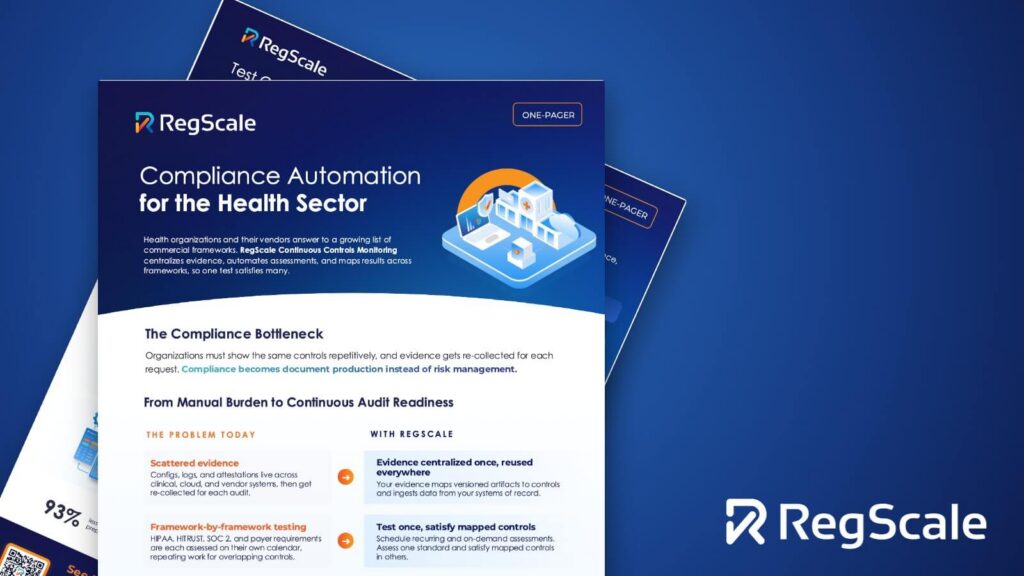
Automated mapping will drive further improvements, empowering organizations to implement an attest once, assess it once, and apply it across scores of standards and frameworks. You only need to provide a single set of evidence once, and the program runs in a continuously audit-ready state instead of scrambling when the auditor shows up. GRC tools like RegScale are now using industry mapping frameworks to improve audit confidence across a broad range of frameworks. We calculated that over a fifth (22%) of organizations are balancing 10+ discrete compliance frameworks. It’s about time we gave compliance teams a break.
Driving Continuous Risk Reduction
Our evidence suggests a third (31%) of compliance teams are still performing framework mapping manually. This exacerbates the challenges of reactive, point-in-time compliance which checks boxes but doesn’t add much else in the way of business value.
The way we win is by building those secure foundations first. Then layering on automation, AI and intelligent mapping. This will position compliance as an initiative that goes way beyond checking off regulatory requirements. GRC in these terms becomes a continuous risk management exercise designed to bolster resilience and trust. It means spending less time manually proving your organization is secure, and more time improving your operational security posture.
Ready to get started?
Choose the path that is right for you!
Skip the line
My organization doesn’t have GRC tools yet and I am ready to start automating my compliance with continuous monitoring pipelines now.
Supercharge
My organization already has legacy compliance software, but I want to automate many of the manual processes that feed it.