

Lord of the Controls, Part 1: Leaving the Shire of Static PDFs

“Three Rings for the Cloud Kings under the federal sky,
Seven for the Auditors in their halls of stone,
Nine for Mortal CISOs doomed to manually reply,
One for the Dark Lord on his SharePoint throne…
One Trust Center to rule them all, One Engine to find them,
One Platform to bring them all, and in the DevSecOps bind them.”
For decades, the cybersecurity and compliance world has been enslaved by a cursed artifact: the One Ring of Manual Paperwork. Forged in the dark ages of compliance, it binds security teams to 800-page Word documents, copy-pasted spreadsheets, and stale screenshots hoarded in glorified SharePoint folders. It whispers to legacy compliance teams in the dark: “My precious PDF…” It convinces them that uploading a static file to a SharePoint portal is the same thing as being secure.
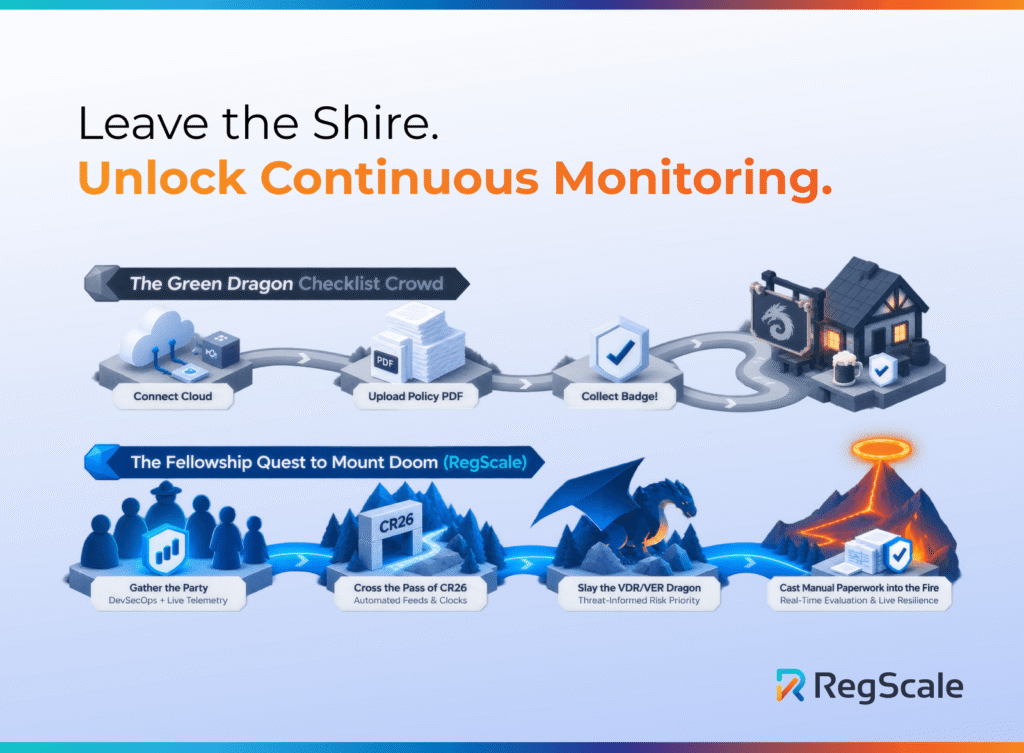
Most “Trust Centers” on the market today don’t destroy that Ring. They tuck it into a prettier velvet pouch and hang it on a peg at the village tavern. They treat compliance like a stroll through the Shire: a sunny, three-step walk (Upload Document → Check Green Box → Second Breakfast!), a pint raised in greeting, and a cheerful “Have you seen the SOC 2 report?”
You cannot defeat modern threats, or survive FedRAMP CR26 and its continuous vulnerability rules, with a hand-drawn map to the tavern and a folder full of shelfware. Over this five-part series, we’re going on a quest: to cast static file-sharing into the fires of Mount Doom and replace it with real-time evaluation, continuous automation, and living operational resilience.
Every great adventure starts the same way. You realize you can’t stay in Hobbiton.
The Green Dragon Checklist Crowd: “Nothing Ever Happens in the Shire”
For the last five years, two kinds of vendors have tried to convince you that you never need to leave the Shire.
First, the Silicon Valley Checklist Crowd at the Green Dragon, the Shire tavern where nothing ever happens: platforms built to get a 12-person startup a fast SOC 2 badge between ping-pong matches. You buy the checklist tool, bolt on the “Trust Portal,” upload a 14-month-old penetration test PDF, put it behind a request-access button, and call it a day. They have never left the tavern, and they will tell you the road is a myth.
It is the Green Dragon Checklist school of security assurance:
- The Map says the whole journey is three painted stops: Connect Cloud → Upload Policy PDF → Collect Badge!
- The Pantry holds a dusty ZIP of Word documents, a spreadsheet last edited by an intern who left two years ago, and a Disaster Recovery Plan nobody has ever tested.
- The Big Question. When an enterprise buyer or federal agency asks whether your controls work right now, the portal blinks for four awkward seconds, raises a mug, and says, “Another round! Look at our green checkmarks!” It ignores the fact that the cloud integration behind that checkmark quietly disconnected three weeks ago.
The access gate isn’t the problem. Every serious trust center controls who sees what. The problem is what’s waiting behind the gate: a document that was out of date the day it was uploaded.
The Scroll-Scribes of Bag End
Second, sitting comfortably at a writing desk in Bag End, you have the Boutique Scroll-Scribes: the “DocOps” point tools that promise to solve federal compliance by helping you draft prettier digital posture files.
Like Bilbo penning There and Back Again, they produce lovely formatting and tidy narratives, with no ability to fight a Balrog. They don’t destroy the paperwork. They translate it into a newer file format. The moment you need live validation, automated risk prioritization, or enforced regulatory clocks, the Scroll-Scribe hands you a scroll and wishes you luck at the edge of the Shire.
The Two Towers Problem
Here’s where the story gets interesting.
When a scroll can’t fight a Balrog, some vendors do what outmatched parties often do in the second act: they form an alliance. One platform collects the evidence, another produces the federal paperwork, and shared controls get synchronized across the gap.
That’s not a Fellowship. It’s the Two Towers: two strongholds, two evidence stores, and a long road between them that your team has to patrol. Every handoff is a place where a control can drift, a mapping can go stale, or a roadmap can change without you.
RegScale doesn’t need an alliance to reach Mount Doom, and we don’t need to borrow anyone’s armor. Evidence is collected once and mapped across FedRAMP 20x Key Security Indicators (KSIs), NIST 800-53 Rev 5, CMMC, and NIST CSF inside one platform, with one evidence store and one source of truth. Continuous monitoring, federal certification, and the Trust Center are the same system, not a handshake between two. And we hold ourselves to the hardest standard on the trail: RegScale is FedRAMP Class D (High) Certified. One Fellowship. One map.
A Trust Center That Only Shares Files Is SharePoint in an Elvish Cloak
That’s the truth this series sets out to prove. To deliver real resilience, you don’t hide the Ring of Manual Paperwork in a prettier portal, or split it between two towers. You march it to Mount Doom and melt it.
The Road Ahead
Here’s the map for the rest of the journey:
- Part 2: The Council of Rivendale and the Pass of CR26. Why a FedRAMP-compatible trust center is now a rule, not a marketing page.
- Part 3: Into the Mines of Moria. AI-speed attackers, the death of the grace period, and the VDR/VER rules.
- Part 4: The Fires of Mount Doom. Honest, real-time evaluation and living resilience, plus choosing your party.
- Part 5: The Return of the King. Why customers, not vendors, are redefining what a trust center is.
Pack light. Leave the second breakfast in the Shire. The road goes ever on.
To find out how RegScale innovation can help your company’s GRC function out of the dark ages of compliance, book a demo today.
Ready to get started?
Choose the path that is right for you!
Skip the line
My organization doesn’t have GRC tools yet and I am ready to start automating my compliance with continuous monitoring pipelines now.
Supercharge
My organization already has legacy compliance software, but I want to automate many of the manual processes that feed it.