

Lord of the Controls, Part 4: The Fires of Mount Doom

Part 4 of 5 in the Lord of the Controls series. [Read Part 3: Into the Mines of Moria.]
This is the climax of the quest. You’ve left the Shire, crossed the Pass of CR26, and survived Moria. Now you’re standing at the Crack of Doom, holding the One Ring of Manual Paperwork.
A Green Dragon portal asks you to polish the Ring, take a screenshot of it, upload Disaster_Recovery_Plan_2023_FINAL_v3.pdf, and chalk a green checkmark on the tavern door, even when the data feed behind it is broken.
RegScale asks you to throw it in the fire.
Honest, Real-Time Evaluation: No More Fake Green Checkmarks
Plenty of trust centers love a wall of green lights. The question nobody asks is: green according to what?
A checkmark with no visible logic behind it is a claim, not evidence. And a checkmark fed by a connector that silently failed last month is worse than no checkmark at all.
In the RegScale Trust Center, evaluation is honest and inspectable:
- Show your work. KSI evaluations run on policy-as-code, and every result shows the rule behind it. An assessor can see why something passed, not just that it passed.
- AI-assisted, human-readable. AI-assisted scoring speeds up evaluation, and teams can create custom checks from plain language instead of hand-writing policy logic.
- Evidence from where work happens. The goal isn’t a better upload button. It’s evidence that flows into your Trust Center automatically from the pipelines, scanners, and cloud environments where you’re already working, so posture keeps pace with every build instead of waiting for the next audit.
- Failure is never silent. When a detection scan fails or weakens, the system can’t show a clean status. A broken feed should look broken, so you and your customers get a posture you can trust.
Living Resilience, Not a Dusty DR Scroll
A PDF never recovered a failed database. A spreadsheet never ran an incident response drill.
This is the heart of what I call the shift from GRC to GRR: Governance, Risk, and Resilience. Compliance should be an outcome of being resilient, not the goal itself. The organizations that win aren’t the ones with the thickest binder. They’re the ones that can take a hit, adapt, and keep flying.
That changes what a trust center should hold. Instead of storing documents about resilience, it should reflect resilience as it’s practiced: business impact analysis tied to real recovery targets like Maximum Tolerable Downtime, exercises that are actually run and scored, and corrective actions that are tracked to closure. When resilience work happens, posture should reflect it. When it falls behind, posture should reflect that too.
That isn’t file sharing. That’s living, breathing resilience.
Choosing Your Party for the Journey Ahead
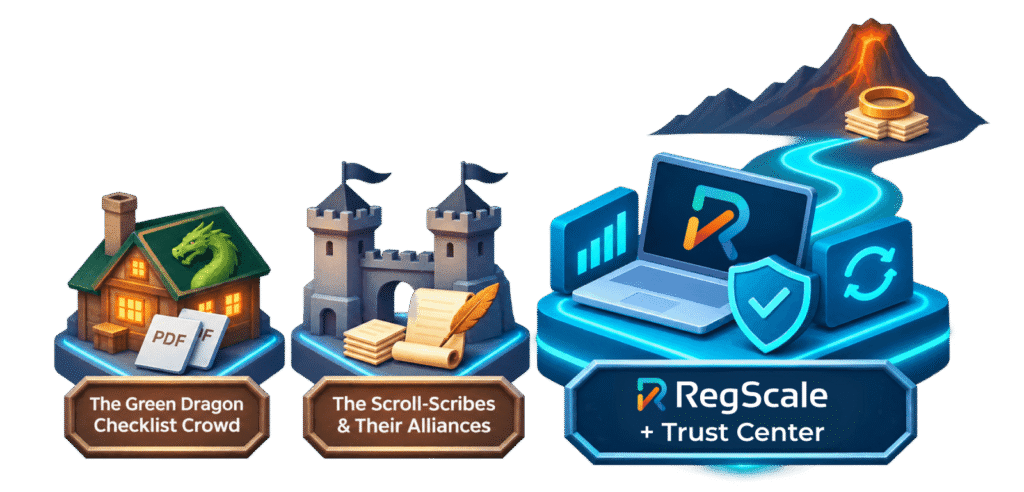
Before you pick who leads your organization into continuous assurance, look at who’s standing in the tavern:
|
Quest requirement |
The Green Dragon Checklist Crowd (static portals) |
The Scroll-Scribes and their alliances |
RegScale + RegScale Trust Center |
|---|---|---|---|
|
What happens to the Ring of Paperwork |
Stored as static PDFs behind a request-access button |
Transcribed into prettier digital scrolls |
Replaced with continuous evaluation and automation |
|
Evidence model |
Manual uploads |
One tool drafts the paperwork, a partner collects the evidence |
One evidence store, collected once, mapped across 20x KSIs, Rev 5, CMMC, and CSF |
|
Who you depend on |
One vendor’s checklist |
Two vendors’ roadmaps, pricing, and APIs staying aligned |
One platform, one roadmap, Class D (High) Certified |
|
20x + Rev 5 dual track |
Commercial checklists; hits a wall on Rev 5 and DoW RMF |
Federal packages from the scribe, commercial evidence from the partner |
Author once, publish both: 20x machine-readable outputs and full Rev 5 SSP / eMASS packages from one source, no replication |
|
CR26 human + machine formats |
PDFs and questionnaires |
Kept in sync across tools |
Human-readable and JSON from a single source, kept consistent by automation |
|
Validation you can trust |
Green checkmarks with no visible logic |
Only as current as the evidence handed over from the partner |
Policy-as-code results that show the rule behind every verdict |
|
VDR / VER |
30/60/90-day calendars |
Depends on which tool holds the scanner data |
Threat-informed: reachability, known exploitation, auto-recalculated deadlines |
|
Regulatory clocks |
Your calendar and your memory |
Partial, depending on tool |
Class-based incident, change, and quarterly clocks with a human in the loop |
|
Resilience |
A PDF of a 2023 DR plan |
Static text about recovery in a form |
Resilience treated as live posture, not a document |
Join the Fellowship
The age of hoarding static PDFs in glorified SharePoint folders, and calling it “trust,” is over. You don’t need another tool that helps you polish the One Ring of Manual Paperwork. You don’t need two towers stitched together with an integration. And you definitely don’t need a Checklist Crowd regular raising a mug and asking your auditors whether they can spot the stale screenshot.
You need one guide built for the whole quest: from fast commercial assurance to FedRAMP CR26, 20x continuous validation, and threat-informed VDR/VER.
One Trust Center to rule them all, One Engine to find them, One Platform to bring them all, and in the DevSecOps bind them.
Gather your party. Let’s cast manual compliance into the fire for good.
Next: Part 5, The Return of the King. Why customers, not vendors, are redefining what a trust center is.
Ready to get started?
Choose the path that is right for you!
Skip the line
My organization doesn’t have GRC tools yet and I am ready to start automating my compliance with continuous monitoring pipelines now.
Supercharge
My organization already has legacy compliance software, but I want to automate many of the manual processes that feed it.