

RegScale Named a Sample Vendor in Gartner® Hype Cycle™ for Site Reliability Engineering, 2026

RegScale has been named a Sample Vendor in the DevOps Continuous Compliance Automation (DCCA) category of the Gartner® Hype Cycle™ for Site Reliability Engineering, 2026.
Gartner notes that, “Heads of I&O can use this Hype Cycle to prioritize the practices, skills and technology essential for turning operational stability into business value”. Although only Gartner subscribers can access the full report, here are our main takeaways.
Drowning in Compliance
Compliance programs simply haven’t kept pace with the velocity and demands of modern software development. Part of the challenge for teams is the sheer volume of requirements. As Gartner explains:
“DevOps organizations must align with a surging volume of regulatory requirements that are evolving at differing rates, and they will continue to do so as more compliance requirements are introduced. These requirements are expanding beyond the traditional areas of finance, health privacy, and personal privacy to include cybersecurity and contractual mandates plus government regulations.”
This growing compliance burden is colliding with business demands, Gartner continues:
“The pressure to deliver software faster and more frequently has accelerated development cycles. Traditional, manual compliance processes can’t keep pace with this speed, making automation essential.”
But when code updates are being pushed many times a day, traditional manual compliance processes come up short. Continuous delivery demands continuous compliance. Yet more often than not, it’s reactive, manual. and documentation heavy.
“Traditional compliance reporting, benchmarking, assessments, and remediation are increasingly too slow to support the needs of high-velocity digital business processes,” according to Gartner.
We Believe Momentum Is Building Behind DCCA
Not only are manual processes slow. They’re prone to human error and often don’t surface compliance issues until late in the cycle; sometimes not even until audit time. That drives up cost, delays delivery, and can slow business growth. Audit fatigue erodes developer productivity and demotivates teams. Additionally, manual processes can create security gaps that threat actors are increasingly capable of exploiting using AI tools.
This is where DCCA comes into its own. As Gartner says: “DCCA tools reduce the risk of compliance violations, which can result in fines, penalties, and reputational damage, and identify compliance gaps and security vulnerabilities early in development.”
At a high level, DCCA works by translating compliance requirements into executable rules so they can be managed like software and embedded into CI/CD pipelines. This way, compliance rules can be continuously version-controlled, tested and enforced throughout the SDLC, just as code is for vulnerabilities. Anything that doesn’t look right is flagged immediately before it hits production, and long before it’s spotted in an audit.
The is the power of compliance as code. It means a shift from point-in-time to continuous compliance— substantially reducing the cost and manual effort of compliance, and freeing DevOps teams to deliver with more confidence and speed. It doesn’t just reduce compliance risk and eliminate drift, but also improves security posture via automated detection and remediation of vulnerabilities and other issues.
In this way, compliance shifts from a burden to an intrinsic part of the way that organizations deliver software. It makes DCCA a no-brainer, as code volumes continue to grow on the back of AI and automated tooling. Gartner describes the business case in clear terms:
“As organizations implement or scale DevOps initiatives, they frequently struggle to effectively establish, measure, enhance, and evidence compliance requirements. Heads of I&O must leverage compliance automation tools to enforce policy guardrails, address gaps in compliance frameworks, and systematically audit security and compliance policies throughout the SDLC to demonstrate continuous and measurable improvement in their compliance posture.”
We believe RegScale is in a great position to help organizations work through these recommendations. As a leader in Continuous Controls Monitoring (CCM) with a powerful CCM-first platform, our focus is on driving DCCA success for customers through compliance as code.
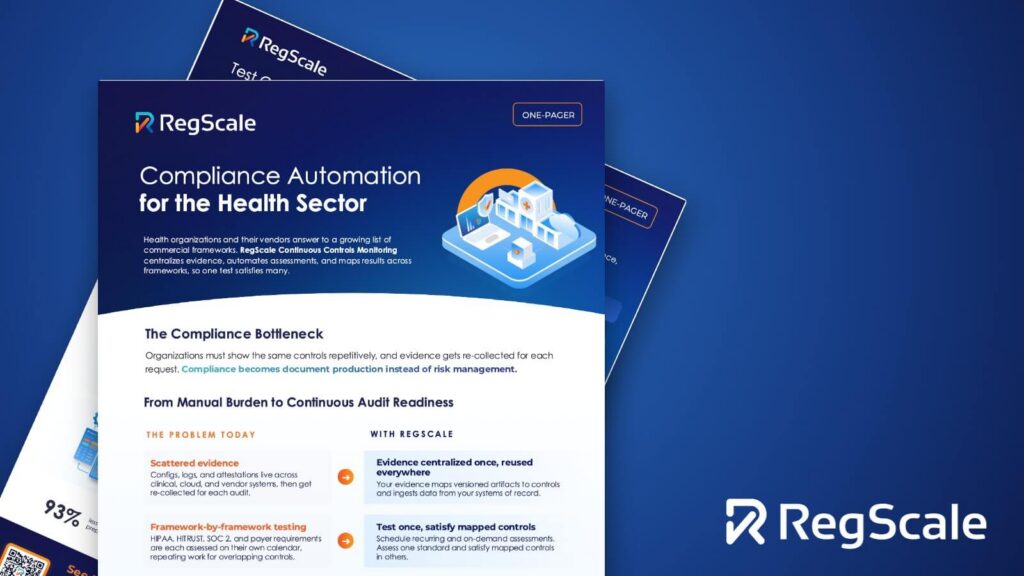
From Shift Left to Shift Down with RegScale
Yet Gartner also points out: “Poorly implemented DCCA presents a business risk. If it is assumed that by implementing DCCA, delivered software becomes compliant without additional effort, organizations will face increased risk of compliance failure.”
In our view, this is where RegScale has an advantage. Our holistic GRC platform is more than just a tool for DevSecOps. It empowers customers with AI technology to close compliance gaps, accelerate remediation, and deliver audit-ready documentation, all from within the same platform. There’s also integration with a range of third-party security scanners, for streamlined issues management. And real-time reporting for continuous visibility into compliance and risk posture.
RegScale for DCCA is not as much about “shift left” as “shift down.” This is the end state for compliance as code, where infrastructure continuously proves its own compliance posture and updates records automatically. Audit work is effectively replaced by telemetry and automated evidence collection.
This is our vision for the future: an AI-powered, “always-audit-ready” compliance model that frees DevOps teams to focus on innovation. As the DCCA category evolves and begins to move towards “early mainstream” maturity, it’s a future that auditors and customers increasingly expect.
Gartner, Hype Cycle for Site Reliability Engineering, 2026, Hassan Ennaciri; Daniel Betts; Chris Saunderson; Paul Wang, 26 May 2026.
Gartner does not endorse any company, vendor, product or service depicted in its publications, and does not advise technology users to select only those vendors with the highest ratings or other designation. Gartner publications consist of the opinions of Gartner’s business and technology insights organization and should not be construed as statements of fact. Gartner disclaims all warranties, expressed or implied, with respect to this publication, including any warranties of merchantability or fitness for a particular purpose.
GARTNER and HYPE CYCLE are trademarks of Gartner, Inc. and its affiliates.
Ready to get started?
Choose the path that is right for you!
Skip the line
My organization doesn’t have GRC tools yet and I am ready to start automating my compliance with continuous monitoring pipelines now.
Supercharge
My organization already has legacy compliance software, but I want to automate many of the manual processes that feed it.