

FedRAMP 20x Just Closed the Cadence Gap. CSPs Have Months, Not Years.

Your threat detection is automated. Your vulnerability scanning is automated. But your compliance program still runs on spreadsheets and monthly scan packages where high risk vulnerabilities are addressed in 30 days. That is where the risk lives, and on June 16, 2026, FedRAMP made risk-based, continuous vulnerability response a certification requirement.
Public Notice NTC-0014 mandates that FedRAMP-authorized cloud service providers accelerate security updates and vulnerability remediation. It responds to CISA’s Binding Operational Directive 26-04, which dictates how federal civilian agencies prioritize and patch vulnerabilities. The message to cloud service providers is clear: prioritize vulnerabilities by actual risk and accelerate your remediation timelines for the highest risk cases – exposed, exploitable, KEV-listed, high-impact – now.
Effective December 7, 2026, the new Vulnerability Detection and Response (VDR) and Vulnerability Evaluation and Reporting (VER) requirements are mandatory for every cloud service offering looking to achieve or keep its FedRAMP certification. These FedRAMP VDR VER requirements represent a fundamental shift in how CSPs must demonstrate compliance. The flat 30-day clock is gone. In its place is a risk-based model: a vulnerability meeting VDR and VER requirements must be remediated based on risk evaluation, with highest impact findings within half a day, while lower-risk vulnerabilities can be addressed on longer timelines or deferred entirely. In plain terms, FedRAMP now wants you to prioritize the way an attacker thinks, not the way an auditor checks.
What VDR and VER actually require
VDR and VER require prioritizing and remediating based on real, live risk: Is the vulnerability internet-reachable? Is it a Known Exploited Vulnerability (KEV)? Is the exploit automatable, and what is the actual technical impact?
Under the new VER rules, you must assume an exploit can be carried out by automated means by default unless you can prove otherwise. This is a massive leap away from just checking the box when a scan completes. It moves toward understanding your actual risk exposure in near-real time.
Why monthly reporting no longer satisfies FedRAMP
For years, the anchor of FedRAMP continuous monitoring has been reporting vulnerability scan results monthly. You’re likely already scanning continuously — the problem is batching the response into a monthly package. FedRAMP is now saying it plainly: that snapshot just does not cut it anymore.
Cyber attacks move at light speed. Compliance programs move at geologic speed. VDR and VER are FedRAMP legislating that gap closed.
The timeline: December 7, 2026 is not a soft deadline
What makes this noteworthy is the acceleration of the change. If you are not following these rules by December 7, the clock starts ticking. After December, CSPs get a brief grace period under a Corrective Action Plan (CAP) to reach compliance. If you are still non-compliant after March 7, 2027, FedRAMP will revoke your certification.
This accelerated schedule is a surprise to the industry. Mandatory adoption was originally slated for June 2027, with a grace period stretching into 2028. With a single notice, FedRAMP and CISA erased six months of runway, making it clear they will not tolerate slow, incremental adoption when federal data is on the line. Providers now have months, not years, to operationalize a completely different way of managing vulnerabilities.
How RegScale closes the gap
This is exactly what we built RegScale to handle.
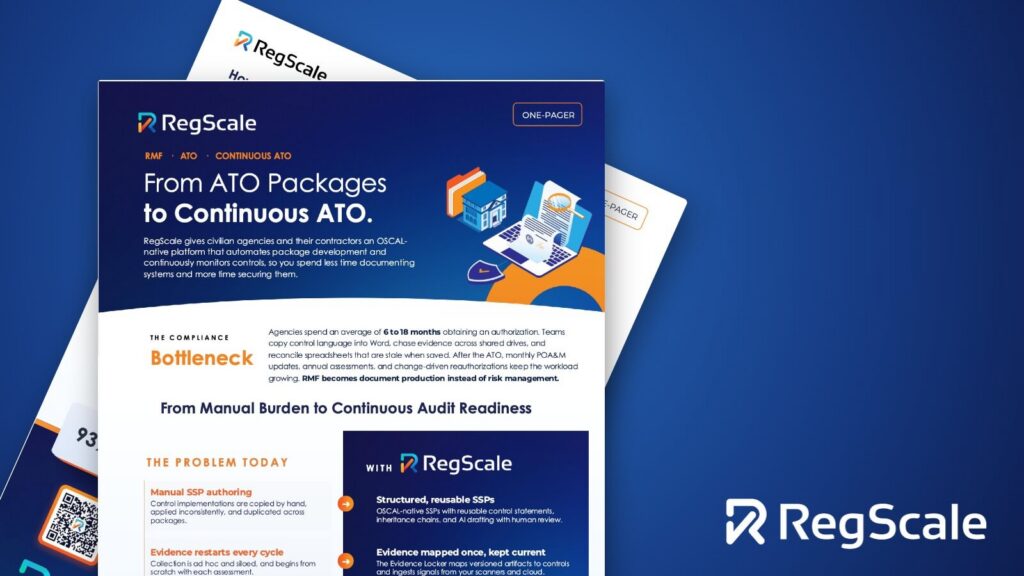
The shift isn’t about assembling a faster scan package – it’s about not running the fire drill at all. Instead of hand-assembling monthly packages, RegScale continuously pulls data from the tools you already use, so your risk profile stays current and you are never relying on a stale snapshot. Our automation workflows carry the load of the new evaluation and reporting rules and produce the machine-readable data that agencies and FedRAMP now demand.
We automate the drudgery, not the judgment. The platform surfaces live, prioritized risk so your team can decide fast. The risk-based call still belongs to your people. That is the point: free the smart people you hired from the work they hate so they can do the work that matters. Your program shifts from periodic scanning drills to continuous, risk-based assurance in weeks, without rebuilding your security program from scratch.
Cloud providers that automate vulnerability management and Continuous Controls Monitoring now will clear December 7 without a scramble, and keep clearing it every day after. CISOs stop prepping for audits and start running programs that are audit-ready, every day. That is what RegScale is built to do.
The deadline will not move. Your readiness can. Book a demo with RegScale to learn how RegScale gets you to December 7 without a scramble.
Ready to get started?
Choose the path that is right for you!
Skip the line
My organization doesn’t have GRC tools yet and I am ready to start automating my compliance with continuous monitoring pipelines now.
Supercharge
My organization already has legacy compliance software, but I want to automate many of the manual processes that feed it.